

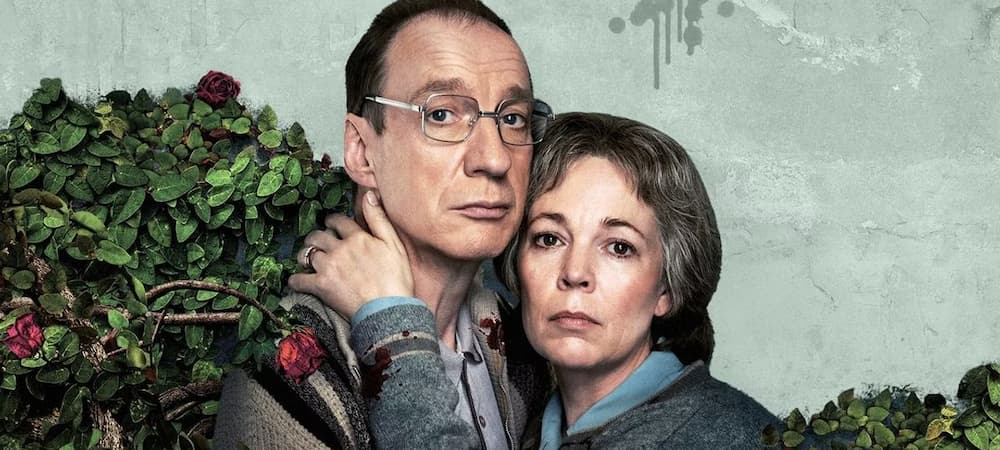
True-crime dramas have become a staple of prestige television, but few have approached the genre with the tonal audacity of Landscapers. The four-part miniseries on HBO, starring Olivia Colman and David Thewlis, reimagined a real-life double murder case through a lens of dark humor, romantic delusion, and psychological fragility.
Rather than presenting a conventional procedural, Landscapers constructed a stylized character study that blurred the line between fantasy and reality. Years after its release, the series continues to be regarded as one of the most inventive crime dramas of the modern era.
A True Crime Story Told Through a Surreal Lens
Olivia Colman at Her Most Unpredictable
At the center of Landscapers is Olivia Colman, whose performance as Susan Edwards anchors the series’ tonal balancing act. Colman, already known for dramatic precision, leans into the character’s vulnerability and eccentricity without losing sight of the darker truths beneath.
Her portrayal avoids caricature. Instead, she crafts a woman suspended between romantic fantasy and stark reality. The result is both unsettling and deeply human.
A Partner in Delusion: David Thewlis
Opposite Colman, David Thewlis delivers a layered performance as Christopher Edwards, Susan’s equally insular husband. Thewlis complements Colman’s fragility with a subdued intensity, reinforcing the couple’s emotional codependency.
Their chemistry transforms Landscapers from a straightforward crime retelling into an exploration of shared fantasy and emotional isolation.
Reinventing the True-Crime Format on HBO
Breaking Away From Procedural Norms
Unlike many crime dramas that emphasize investigative mechanics, Landscapers reframes the narrative around the accused. The miniseries frequently breaks the fourth wall, transitions between theatrical sets, and visually reflects the characters’ inner fantasies.
This unconventional storytelling approach distinguishes it from more traditional offerings in the genre.
A Stylistic Gamble That Paid Off
On HBO, a network synonymous with prestige programming, Landscapers stood out for its willingness to experiment. The minimalist production design—often shifting between constructed sets and emotional memory—emphasized psychological perspective over realism.
The gamble reinforced that crime storytelling can be as much about perception as evidence.
Why Landscapers Still Resonates
True Crime With Emotional Complexity
In an era saturated with grim procedural content, Landscapers offers something more intimate. It interrogates how ordinary people rationalize extraordinary wrongdoing.
The show does not excuse its subjects but seeks to understand them, presenting crime not as spectacle but as a tragic culmination of emotional distortion.
A Showcase for Olivia Colman’s Range
Though Colman has delivered acclaimed performances across film and television, Landscapers remains one of her most nuanced roles. She navigates tonal shifts—from whimsical escapism to chilling realization—with remarkable control.
The performance solidifies her reputation as one of the most versatile actors working today.
A Compact Miniseries With Lasting Impact
Four Episodes, One Complete Arc
The four-episode structure enhances the show’s narrative precision. Each installment builds on the previous one, gradually peeling back the layers of fantasy and denial surrounding the central crime.
For viewers seeking a contained crime story with psychological depth, Landscapers offers a focused, immersive experience.
A Benchmark for Artistic Crime Drama
As streaming platforms continue to produce high volumes of true-crime content, Landscapers remains a benchmark for artistic ambition within the genre. Its fusion of theatrical staging, emotional realism, and dark humor continues to set it apart.
A Crime Drama Unlike Any Other
With Olivia Colman and David Thewlis delivering career-highlight performances, Landscapers stands as one of HBO’s most daring limited series. Its refusal to conform to standard crime storytelling conventions makes it enduringly compelling.
Rather than simply recounting a case, the miniseries explores how narrative itself shapes perception—both for its characters and its audience.
In the crowded landscape of true-crime television, Landscapers remains a singular achievement: intimate, inventive, and anchored by performances that linger long after the credits roll.